
Bu sayfa henüz sizin dilinizde mevcut değil. İngilizce gösteriliyor.
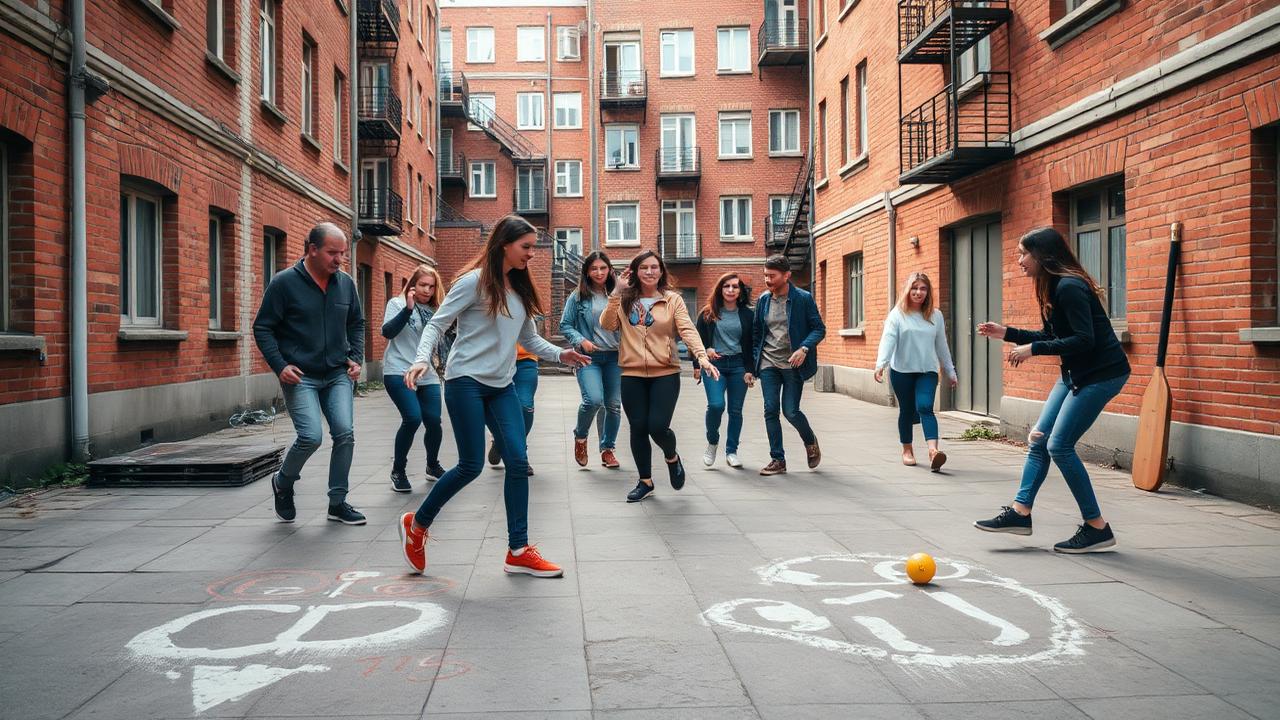
A historic Polish bat-and-ball team game: the batting team hits the ball into the field and runs between marked points, while the fielding team recovers the ball and tries to stop them. It is one of the European ancestors of baseball and cricket.
Kültürel bağlam
Palant has been played in Poland since at least the 16th century in schools, villages and army units, and was for a long time the country's most popular team game before football displaced it. It is now being revived by associations and schools as sporting heritage, and its simple rules and minimal equipment make it very well suited to inclusive settings.
Nasıl oynanır
1. Mark a batting line, a field and two or more running points (bases) with cones.
2. Split into a batting team and a fielding team.
3. A server tosses the ball to the batter, who strikes it with the bat into the field.
4. After a valid hit the batter runs to the base and, if possible, back.
5. Fielders recover the ball and return it to the server, or hit the runner according to the agreed variant, to stop the run.
6. Each completed run scores a point. When the batting team is out, the teams swap.
7. Play a fixed number of innings or to an agreed score.
Kapsayıcı uyarlamalar
DRAFT FOR PARTNER REVIEW — this text was written by the coordination team and must be validated by the partner that contributed the game.
Reduced mobility and disability
Offer three ways to put the ball in play — bat, throw by hand, or push from a tee — and let each participant choose without any loss of points. Shorten the distance to the base individually, and allow a runner partner for participants who cannot run: the batter hits and the partner runs, with the batter deciding when to stop. Use a larger, softer, slower ball and a lighter bat with a thicker grip for reduced grip strength. Wheelchair users bat from a tee at chair height and travel a shortened base route on a smooth surface. Blind and partially sighted players use an audible ball, a tee, and a caller at each base.
Multilingual groups and newcomers
Introduce the game without words first: the facilitator plays one full round while the group watches, then a second round in slow motion naming only three or four key words in the local language. Print the key words on cards with a simple drawing (start, go, stop, your turn, point) and keep them visible. Pair each newcomer with a peer buddy for the first two rounds; the buddy demonstrates rather than translates. Never let understanding the rules become a condition for joining — anyone can enter mid-round.
Mixed-gender and mixed-age groups
Build mixed teams by drawing lots, never by letting captains pick. Guarantee that every participant takes the same number of active turns and rotate every role — including the visible, decisive ones — so that scoring, throwing or leading is not monopolised by the most confident or the oldest players. Watch for symbolic participation: a turn that nobody watches or that cannot affect the result is not participation. When ages or body sizes differ widely, adjust distances or scoring per player rather than creating a separate 'easy' group.
Güvenlik notları
DRAFT FOR PARTNER REVIEW — this text was written by the coordination team and must be validated by the partner that contributed the game.
The bat is the main hazard: define a clear no-entry zone around the batter, teach players to drop the bat rather than throw it after hitting, and let nobody stand behind the batter. Use a soft ball only. Fielders keep a minimum distance from the batting line. Check the field for holes before starting and mark the boundaries so runners do not sprint towards obstacles. Avoid a close catcher position entirely.
Öğrenme kazanımları
DRAFT FOR PARTNER REVIEW — this text was written by the coordination team and must be validated by the partner that contributed the game.
Participants develop striking coordination, running, throwing, catching and above all reading the game as a team. Palant shows a European sporting heritage most participants have never heard of, which reframes "traditional" as something modern and shared. The three-way choice of hitting method makes inclusion structural rather than exceptional: nobody has to ask for an adaptation.
Bu sayfada
- Köken ülke
- Poland
- Kategori
- Sport
- Hedef yaş
- 13–30
- Fiziksel yoğunluk
- Medium
- Kapsayıcılık odağı
- Mixed
- Malzemeler
- Wooden bat (palant), soft ball, cones for the bases and field limits, bibs