

Bu sayfa henüz sizin dilinizde mevcut değil. İngilizce gösteriliyor.
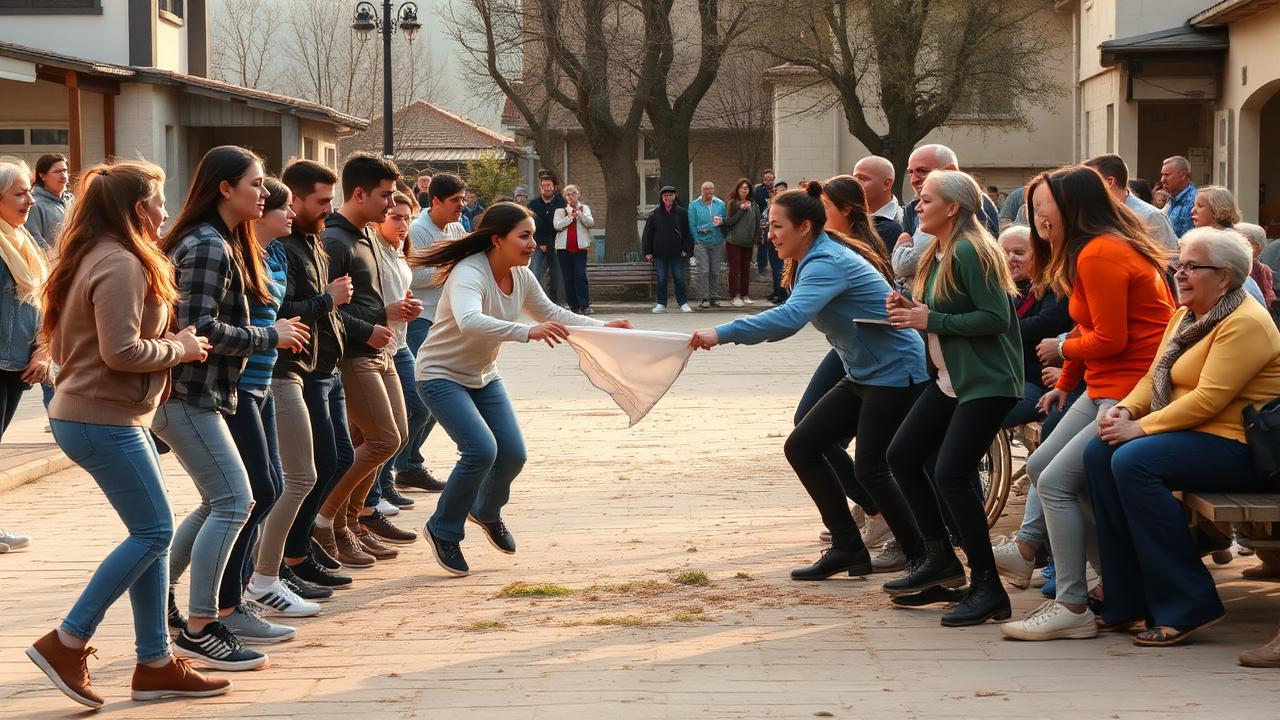
A two-phase team game: a stack of nine tiles is knocked down with a ball, and the real game begins afterwards, when one team tries to rebuild the stack while the other tries to hit them with the ball.
Kültürel bağlam
Dokuz Kiremit is a classic Turkish street and schoolyard game and belongs to the widespread family of "seven stones" games found from the Balkans to South Asia. It needs only tiles and a ball, which is exactly why it spread: it was a game for children with no equipment.
Nasıl oynanır
1. Stack the nine tiles in the centre of the field.
2. Split the group into two teams, one attacking and one defending. Mark a throwing line 5–6 m from the stack.
3. Attackers take turns throwing the ball to knock the stack over. Each team has three attempts.
4. If the stack falls, the attacking team scatters and tries to rebuild it.
5. The defending team recovers the ball and tries to hit the attackers, below the waist, before the stack is rebuilt.
6. If the stack is rebuilt the attackers score; if all attackers are hit first the defenders score. Then the teams swap roles.
Kapsayıcı uyarlamalar
DRAFT FOR PARTNER REVIEW — this text was written by the coordination team and must be validated by the partner that contributed the game.
Reduced mobility and disability
Use a soft ball and place the tile stack on a table or bench so seated players can rebuild it without reaching the floor. Give each thrower a personal distance to the stack. Wheelchair users and players with reduced mobility play with a protected radius — they cannot be targeted from closer than 4 m — and a no-elimination rule in which a hit costs a point rather than removing the player. A walking-only variant applies to the whole group when speeds differ widely and turns the game into one of positioning and passing. Blind and partially sighted players work in a fixed rebuild position with a partner describing the stack state, and use a ball with a bell.
Multilingual groups and newcomers
Introduce the game without words first: the facilitator plays one full round while the group watches, then a second round in slow motion naming only three or four key words in the local language. Print the key words on cards with a simple drawing (start, go, stop, your turn, point) and keep them visible. Pair each newcomer with a peer buddy for the first two rounds; the buddy demonstrates rather than translates. Never let understanding the rules become a condition for joining — anyone can enter mid-round.
Mixed-gender and mixed-age groups
Build mixed teams by drawing lots, never by letting captains pick. Guarantee that every participant takes the same number of active turns and rotate every role — including the visible, decisive ones — so that scoring, throwing or leading is not monopolised by the most confident or the oldest players. Watch for symbolic participation: a turn that nobody watches or that cannot affect the result is not participation. When ages or body sizes differ widely, adjust distances or scoring per player rather than creating a separate 'easy' group.
Güvenlik notları
DRAFT FOR PARTNER REVIEW — this text was written by the coordination team and must be validated by the partner that contributed the game.
Never use real ceramic roof tiles with any group — use wooden, foam or thick plastic plates that cannot shatter or cut. Only soft balls; hits below the waist only; head hits stop the round. Keep the rebuild area clear of hard obstacles because players crouch and turn quickly there. Check the surface for anything that could cause a fall.
Öğrenme kazanımları
DRAFT FOR PARTNER REVIEW — this text was written by the coordination team and must be validated by the partner that contributed the game.
Participants develop throwing accuracy, agility, rapid decision making and cooperative planning, since rebuilding the stack requires shared roles. The role swap between attack and defence gives every participant both the exposed and the protected experience, which makes it a useful game for talking about pressure, exclusion and mutual protection in a team.
Bu sayfada
- Köken ülke
- Türkiye
- Kategori
- Game
- Hedef yaş
- 13–30
- Fiziksel yoğunluk
- Medium
- Kapsayıcılık odağı
- Mixed
- Malzemeler
- Nine flat wooden or plastic plates, one soft ball, chalk to mark the stack position and the throwing line