

Ta strona nie jest jeszcze dostępna w Twoim języku. Wyświetlamy wersję angielską.
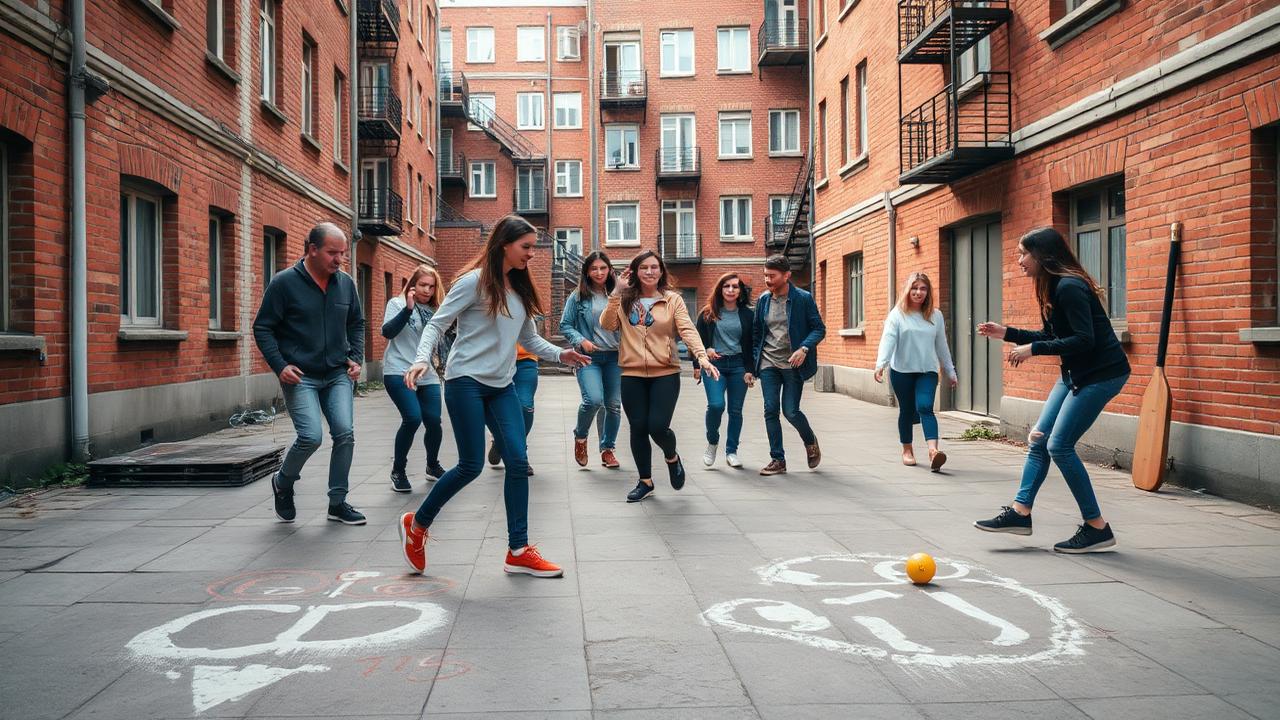
Rhythmic jumping over a rope, alone or in a group, from single basic jumps to long-rope routines with several jumpers, counting rhymes and coordinated entries and exits.
Kontekst kulturowy
Skakanka is a courtyard classic in Poland, traditionally played in groups with counting rhymes passed from one generation of children to the next. Group rope games are found across Europe and the world; the rhymes are local, the movement is universal, and the practice sits at the border between sport, music and language.
Jak grać
1. Individual: each player takes a rope adjusted to their height — the ends reach the armpits when standing on the middle — and jumps continuously, from the basic jump to alternating feet and faster patterns.
2. Long rope: two turners swing the rope steadily while the others queue.
3. Jumpers enter on the beat, jump an agreed number of times, and exit without stopping the rope.
4. Add a counting rhyme; the group chants while jumping.
5. Progress to two jumpers at once, or to entry-exit chains where the rope never stops.
6. Rotate the turners regularly so nobody spends the session turning.
Adaptacje włączające
DRAFT FOR PARTNER REVIEW — this text was written by the coordination team and must be validated by the partner that contributed the game.
Reduced mobility and disability
In long-rope variants, replace jumping with an alternative on the beat: stepping over a slowly swung rope, a wave rope kept on the ground (the "snake"), or clapping and chanting as a full member of the rotation. Wheelchair users pass through a slowly turned rope timed by the turners, or follow the same rhythm with arm-circle rope patterns. Reduce the tempo for the whole group rather than making a separate slow group. Turning the rope is a genuine role, not a sideline — but it must rotate. Blind and partially sighted players jump to a called beat with the rope brushing the ground audibly, starting from a stationary rope.
Multilingual groups and newcomers
Introduce the game without words first: the facilitator plays one full round while the group watches, then a second round in slow motion naming only three or four key words in the local language. Print the key words on cards with a simple drawing (start, go, stop, your turn, point) and keep them visible. Pair each newcomer with a peer buddy for the first two rounds; the buddy demonstrates rather than translates. Never let understanding the rules become a condition for joining — anyone can enter mid-round.
Mixed-gender and mixed-age groups
Build mixed teams by drawing lots, never by letting captains pick. Guarantee that every participant takes the same number of active turns and rotate every role — including the visible, decisive ones — so that scoring, throwing or leading is not monopolised by the most confident or the oldest players. Watch for symbolic participation: a turn that nobody watches or that cannot affect the result is not participation. When ages or body sizes differ widely, adjust distances or scoring per player rather than creating a separate 'easy' group.
Uwagi dotyczące bezpieczeństwa
DRAFT FOR PARTNER REVIEW — this text was written by the coordination team and must be validated by the partner that contributed the game.
Ropes strike hard: keep at least 2 m of clear space around each individual jumper and 3 m around a long rope. Jump on a shock-absorbing, non-slip surface, never on concrete for long sessions, and wear supportive shoes. Limit continuous jumping to short intervals with rest, because it is more intense than it feels. Never swing a rope towards a face or wrap it around anybody, and stop the rope immediately if a jumper stumbles.
Efekty uczenia się
DRAFT FOR PARTNER REVIEW — this text was written by the coordination team and must be validated by the partner that contributed the game.
Participants improve cardiovascular fitness, coordination, rhythm and lower-limb strength — the highest true HEPA load in the collection. Group variants build timing, trust and cooperation, since a successful entry depends on the turners. The rhymes give a natural language-learning moment in multilingual groups: each country teaches its own chant and the group learns all four.
Na tej stronie
- Kraj pochodzenia
- Poland
- Kategoria
- Game
- Wiek uczestników
- 13–30
- Intensywność fizyczna
- Medium
- Obszar włączania
- Mixed
- Materiały
- Individual skipping ropes, one long rope (4–5 m) for group variants, flat non-slip surface, optional music