

Esta página aún no está disponible en tu idioma. Se muestra en inglés.
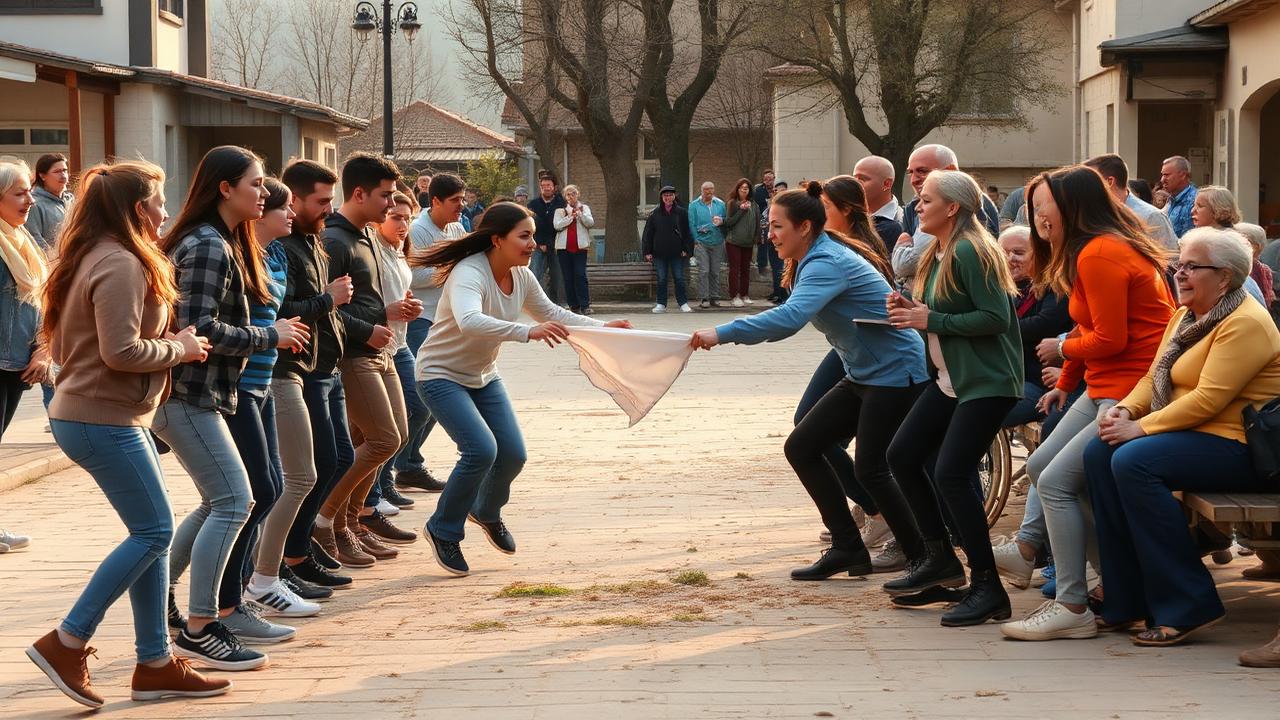
Two teams line up facing each other and each player is given a number. A referee stands in the middle holding a handkerchief; when a number is called, the two players with that number sprint for the handkerchief and try to get it home without being tagged.
Contexto cultural
Mendil Kapmaca is played in schoolyards, village squares and at festivals across Türkiye and is one of the best known Turkish children's games. It needs one object and a flat surface, which is why it has survived generations, and it belongs to a family of snatch games found around the Mediterranean and the Balkans.
Cómo se juega
1. Mark two lines 15–20 m apart and a centre point between them.
2. Split the group into two teams of equal size, lined up behind their line, and number the players 1, 2, 3… on each side so that each player has a counterpart.
3. The referee stands at the centre holding the handkerchief at arm's length.
4. The referee calls a number and the two players with that number run to the centre.
5. A player may grab the handkerchief and run back to their line. If they reach it untagged their team scores; if the opponent tags them first the opposing team scores.
6. Players return to their lines and a new number is called. Play to an agreed score.
Adaptaciones inclusivas
DRAFT FOR PARTNER REVIEW — this text was written by the coordination team and must be validated by the partner that contributed the game.
Reduced mobility and disability
Reduce the distance between the lines to 6–8 m, or set a different distance per pair so each duel is genuinely even. Wheelchair users and players with reduced mobility are matched with counterparts at the same distance and pace, on a smooth, obstacle-free surface. A walking-only variant for the whole group makes the duel about anticipation and feinting rather than sprinting. Alternative roles — referee, number caller, scorer — rotate through the whole group so nobody is parked in them. Blind and partially sighted players run a lane with a guide rope or sighted guide, and the handkerchief carries a bell.
Multilingual groups and newcomers
Introduce the game without words first: the facilitator plays one full round while the group watches, then a second round in slow motion naming only three or four key words in the local language. Print the key words on cards with a simple drawing (start, go, stop, your turn, point) and keep them visible. Pair each newcomer with a peer buddy for the first two rounds; the buddy demonstrates rather than translates. Never let understanding the rules become a condition for joining — anyone can enter mid-round.
Mixed-gender and mixed-age groups
Build mixed teams by drawing lots, never by letting captains pick. Guarantee that every participant takes the same number of active turns and rotate every role — including the visible, decisive ones — so that scoring, throwing or leading is not monopolised by the most confident or the oldest players. Watch for symbolic participation: a turn that nobody watches or that cannot affect the result is not participation. When ages or body sizes differ widely, adjust distances or scoring per player rather than creating a separate 'easy' group.
Notas de seguridad
DRAFT FOR PARTNER REVIEW — this text was written by the coordination team and must be validated by the partner that contributed the game.
The main risk is a head-on collision at the centre: teach players to approach on their own right-hand side and never to dive. Keep the run-out area behind each line free of walls, benches and spectators by at least 3 m. Play on a non-slip surface and stop the game when it is wet. Tagging is an open-hand touch on the back or shoulder only — pulling clothing or grabbing arms ends the round. Warm up before the first sprint.
Resultados de aprendizaje
DRAFT FOR PARTNER REVIEW — this text was written by the coordination team and must be validated by the partner that contributed the game.
Participants develop reaction speed, acceleration, feinting and decision making under pressure (HEPA). Because numbers are called at random, everyone plays and nobody is picked last. The duel format makes the effect of adapted distances immediately visible to the group, which makes it an excellent game for opening a conversation about what fairness means.
En esta página
- País de origen
- Türkiye
- Categoría
- Game
- Edad recomendada
- 13–30
- Intensidad física
- Medium
- Enfoque de inclusión
- Mixed
- Materiales
- One handkerchief, cones or chalk to mark the two lines and the centre, numbered cards or bibs