
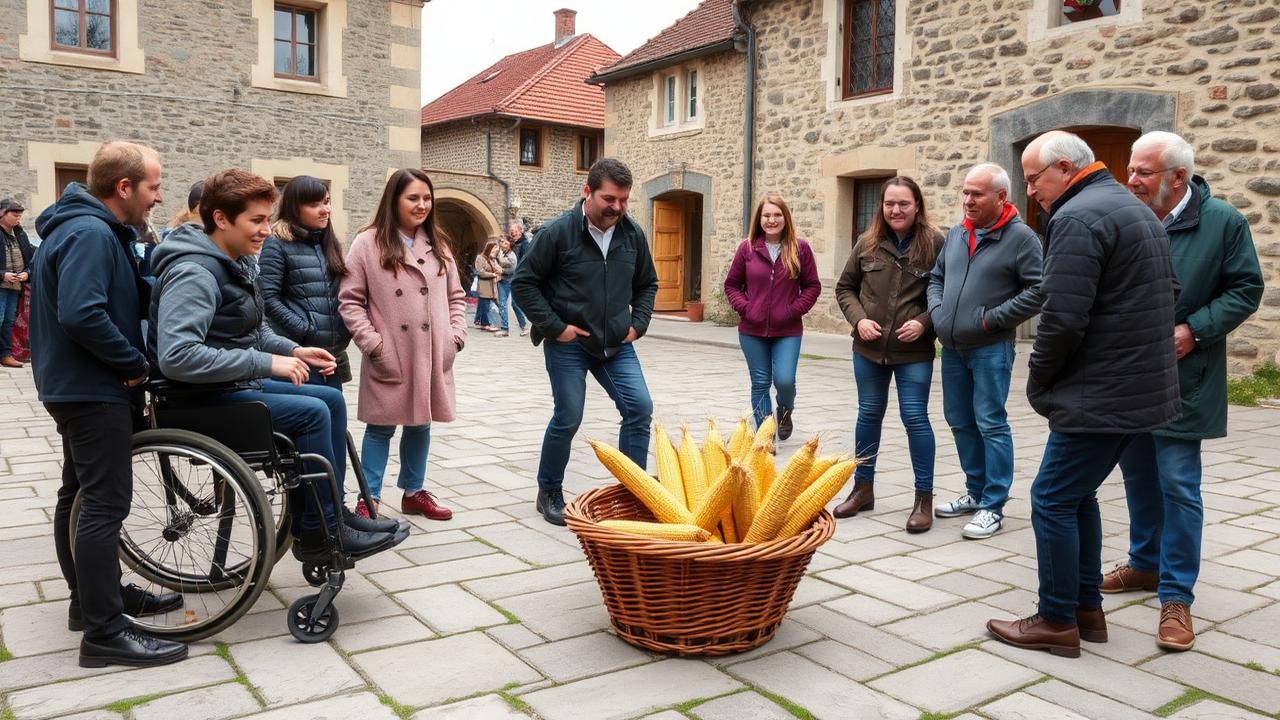
A Basque rural sport in which a single player collects twenty-five wooden cobs, one by one, and carries each of them back to a basket. It measures endurance, rhythm and concentration rather than raw strength.
Cultural context
Lokotxak comes from the maize harvest of Basque farmhouses (baserriak), where gathering cobs quickly was ordinary work that turned into a village competition on festival days. It is still contested at rural sport festivals in Gipuzkoa and Bizkaia and is one of the most recognisable herri kirolak (people's sports).
How to play
1. Place the basket at one end of the play area.
2. Lay the 25 cobs in a straight line, the first cob 1.25 m from the basket and each following cob 1.25 m further apart.
3. On the signal the player runs to the nearest cob, picks it up, returns and drops it in the basket.
4. The player then runs to the next cob and repeats, always carrying one cob at a time.
5. The round ends when all 25 cobs are in the basket. Time is recorded, or players compete head to head in parallel lanes.
6. A cob that falls outside the basket must be picked up and placed correctly before the next run.
Inclusive adaptations
DRAFT FOR PARTNER REVIEW — this text was written by the coordination team and must be validated by the partner that contributed the game.
Reduced mobility and disability
Shorten the line: use 8–12 cobs spaced 0.6 m apart so the total distance suits the group. Wheelchair users play on a flat, hard surface with cobs placed on low cones or a raised rail at hand height instead of on the ground, and may use a grabber stick. Participants with reduced stamina play in relay pairs, alternating cobs. A seated version places the basket beside the player while a partner rolls the cobs within reach, keeping the same rhythm and counting. Blind and partially sighted players follow a guide rope along the lane, with cobs against tactile markers and a caller at the basket.
Multilingual groups and newcomers
Introduce the game without words first: the facilitator plays one full round while the group watches, then a second round in slow motion naming only three or four key words in the local language. Print the key words on cards with a simple drawing (start, go, stop, your turn, point) and keep them visible. Pair each newcomer with a peer buddy for the first two rounds; the buddy demonstrates rather than translates. Never let understanding the rules become a condition for joining — anyone can enter mid-round.
Mixed-gender and mixed-age groups
Build mixed teams by drawing lots, never by letting captains pick. Guarantee that every participant takes the same number of active turns and rotate every role — including the visible, decisive ones — so that scoring, throwing or leading is not monopolised by the most confident or the oldest players. Watch for symbolic participation: a turn that nobody watches or that cannot affect the result is not participation. When ages or body sizes differ widely, adjust distances or scoring per player rather than creating a separate 'easy' group.
Safety notes
DRAFT FOR PARTNER REVIEW — this text was written by the coordination team and must be validated by the partner that contributed the game.
Check the surface for holes, gravel and wet patches before starting; the game is a repeated sprint with sharp turns. Warm up ankles and calves. Keep at least 2 m between parallel lanes and never let spectators stand at the turning points. Use smooth, splinter-free wooden cobs and a basket with no sharp rim. Provide water and enforce rest between rounds — the temptation to keep going is the main injury risk. Stop immediately if a player limps or loses rhythm.
Learning outcomes
DRAFT FOR PARTNER REVIEW — this text was written by the coordination team and must be validated by the partner that contributed the game.
Participants improve aerobic endurance, acceleration and change of direction (HEPA). They learn to pace an effort over time instead of sprinting once, and to count and self-monitor. Culturally, they connect a sporting gesture to Basque rural work and understand why heritage sport is living practice rather than folklore. In the inclusive version they experience first hand that changing distance and equipment changes who can win — and that this is fair, not charity.
On this page
- Country of origin
- Spain
- Category
- Sport
- Target age
- 13–30
- Physical intensity
- Medium
- Inclusion focus
- Mixed
- Materials
- 25 wooden corn cobs, one basket, marked play area 30–35 m long, chalk or tape to mark cob positions, stopwatch