

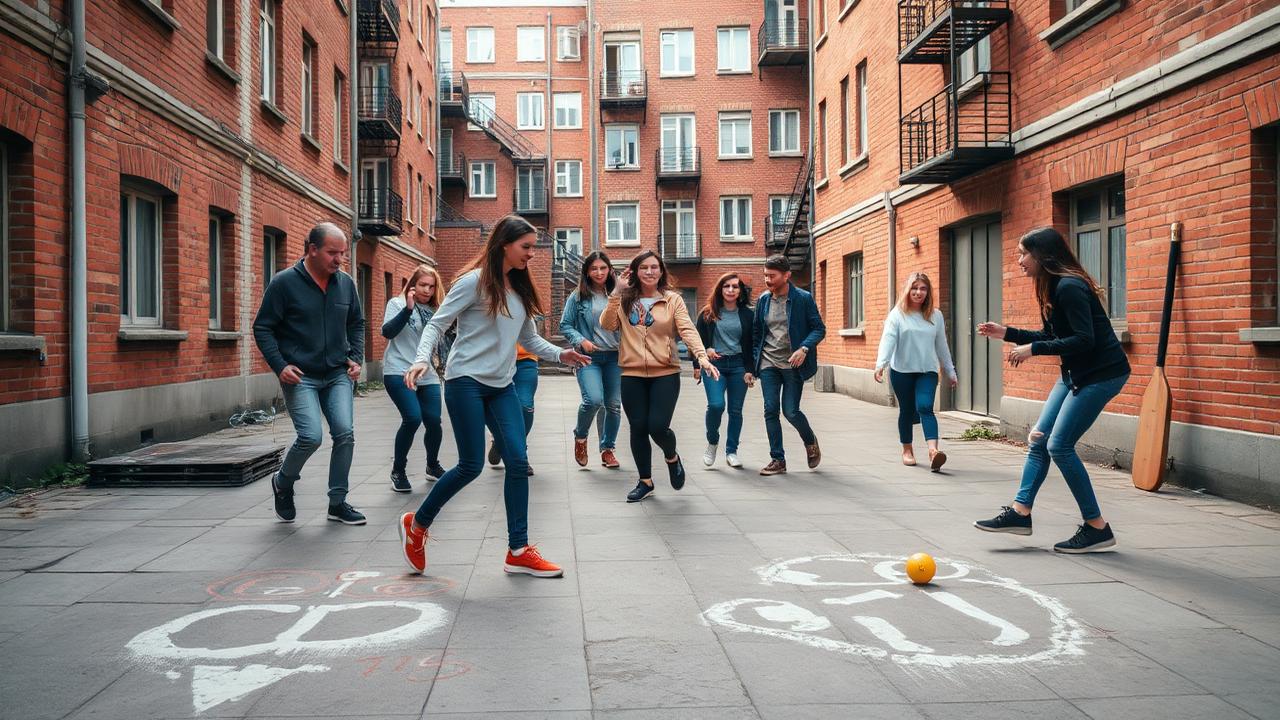
A precision game in which players roll or throw their balls trying to finish as close as possible to a small target marker. Simple to explain, endlessly repeatable, and playable almost anywhere.
Cultural context
Ball-to-target games are part of the courtyard and park play culture of Poland and belong to the same European family as French pétanque, Italian bocce and English bowls. In Poland they are typically improvised: any small balls, any flat patch of ground, any object as the target.
How to play
1. Mark a throwing line and place the target marker 5–8 m away.
2. Each player or team takes an equal number of balls of their colour.
3. Players take turns rolling or throwing one ball at a time, trying to stop it close to the target.
4. A ball may displace other balls and the target; the new position counts.
5. When all balls are played, measure: the player or team with the ball closest to the target scores, plus one point for each further ball closer than the best opposing ball.
6. Play several ends, moving the target each time.
Inclusive adaptations
DRAFT FOR PARTNER REVIEW — this text was written by the coordination team and must be validated by the partner that contributed the game.
Reduced mobility and disability
Set an individual throwing line for each participant, marked discreetly with tape. The game is fully playable seated: wheelchair users roll from a chair, and a launching ramp lets a participant with very limited arm function aim and release with a small movement or a partner-assisted push that the player directs. Use lighter or larger balls for reduced grip. On grass, switch to a hard, smooth surface so balls travel predictably for everyone. Blind and partially sighted players are guided by a caller who taps the target and describes distances after each throw, and the target may carry a bell.
Multilingual groups and newcomers
Introduce the game without words first: the facilitator plays one full round while the group watches, then a second round in slow motion naming only three or four key words in the local language. Print the key words on cards with a simple drawing (start, go, stop, your turn, point) and keep them visible. Pair each newcomer with a peer buddy for the first two rounds; the buddy demonstrates rather than translates. Never let understanding the rules become a condition for joining — anyone can enter mid-round.
Mixed-gender and mixed-age groups
Build mixed teams by drawing lots, never by letting captains pick. Guarantee that every participant takes the same number of active turns and rotate every role — including the visible, decisive ones — so that scoring, throwing or leading is not monopolised by the most confident or the oldest players. Watch for symbolic participation: a turn that nobody watches or that cannot affect the result is not participation. When ages or body sizes differ widely, adjust distances or scoring per player rather than creating a separate 'easy' group.
Safety notes
DRAFT FOR PARTNER REVIEW — this text was written by the coordination team and must be validated by the partner that contributed the game.
Use balls that do not bounce hard; metal boules are not recommended for mixed youth groups. Nobody walks into the playing area while a ball is in play, and measurement happens only when the facilitator calls the end. Watch for toes, because balls are rolled low and land near feet. Play away from slopes and walkways.
Learning outcomes
DRAFT FOR PARTNER REVIEW — this text was written by the coordination team and must be validated by the partner that contributed the game.
Participants develop force calibration, trajectory judgement, spatial estimation and tactical thinking such as blocking, displacing and protecting a position. The low physical load and the personal throwing line make it one of the easiest games to run with a fully mixed-ability group, and the measuring phase creates natural cooperation between opponents.
On this page
- Country of origin
- Poland
- Category
- Game
- Target age
- 13–30
- Physical intensity
- Medium
- Inclusion focus
- Mixed
- Materials
- Set of small balls in two colours, one target marker, chalk or tape for the throwing line, measuring tape